
DIMARTS A COMPÀS
24 November 2026 | 7 pm
Taller de Músics 24 (Cendra, 24. 08001 Barcelona)
TICKETS
An Artistic Compost Heap: The LabF Methodology
The Laboratory for Research from Flamenco (LabF), a project conceived and led by Juan Carlos Lérida, choreographer and lecturer in Flamenco, Improvisation and Composition at the Institut del Teatre, was founded at the same institution in late 2017. Its aim is to “promote encounters between artists, researchers and theorists in the performing arts who, brought together in a shared space, extract, expand and develop lines of research emerging from the study of flamenco through contemporary thought and practice” (see link to the Laboratory’s blog).
Indeed, the first two words used to define this project are already a statement of intent, as they imply community and commitment: a conscious collaboration centred on reflection and experimentation. This is a common aspiration in academic circles, but one that has traditionally been less present in flamenco. However, the most significant word here is, paradoxically, the preposition “from”: flamenco is the starting point, not the focus.
In this session of the Dimarts a Compàs cycle, the seventh and final one of the season, we will explore the Laboratory’s methodology of performative artistic research, breaking with convention and departing from the cycle’s usual format. Led by Juan Carlos Lérida and joined by cantaor Jorge Mesa, el Pirata, we will bring the Laboratory’s experience to the Taller de Músics 24 venue, exploring its distinctive working method and using improvisation “in”, “with” and “from” flamenco (concepts developed by Juan Carlos himself) as a means of artistic research.
The session will also feature special contributions from Carmela Muñoz, dancer and choreographer, and Salvador S. Sánchez, playwright and performer. Both teach at the Institut del Teatre and are founding members of the Laboratory. The header photograph is by Esther Solé, also a member of LabF.
Session language: Spanish
LabF Blog | “The Improvisation of Flamenco Dance: An Expanded Perspective” (Juan Carlos Lérida, 2024)
Dimarts a Compàs is part of the Ciutat Flamenco festival, an initiative by Taller de Músics held annually in Barcelona, bringing together tradition, experimentation and new generations of flamenco art.
BIOGRAPHIES
Juan Carlos Lérida
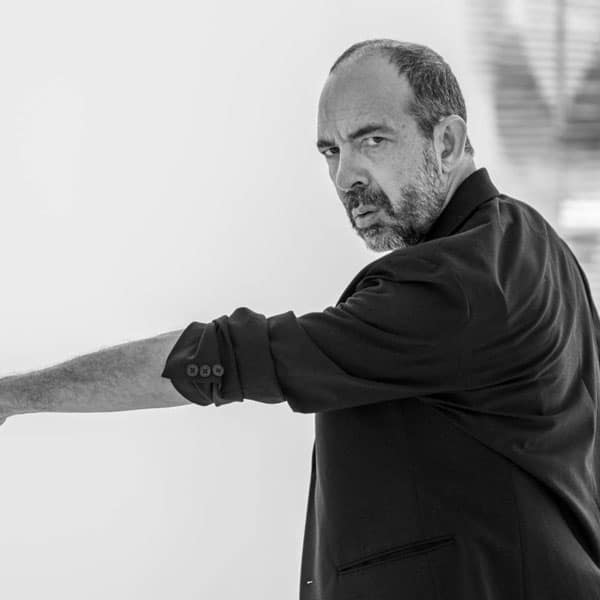
Photo: Germán Antón
Born in Fulda (Germany) and raised in Seville, he began studying dance and flamenco at the age of three. As a young man, he went on to broaden his training with studies in Drama and Contemporary Dance at the Centro Andaluz de Teatro (Seville), as well as Dance Theatre and Improvisation with Mercedes Boronat (Barcelona). Since 2002, he has been a lecturer in Flamenco, Improvisation and Composition at the Institut del Teatre in Barcelona, and regularly teaches workshops on flamenco improvisation and composition as a guest lecturer in several European countries. He has also curated the Flamenco Empírico series at Mercat de les Flors (2009–2012) and the Festival Flamenco at Tanzhaus Düsseldorf (2020–2023). Since 2017, he has led and coordinated the Laboratory for Research from Flamenco (LabF) at the Institut del Teatre.
In terms of his choreographic work, it was in Catalonia that he created his first pieces with his dance company 2D1, receiving awards at national competitions. In 2006, he premiered El arte de la guerra at the Berlin Flamenco Festival, a work that established him as one of the leading figures in avant-garde flamenco. In 2010, he premiered Al Toque in Vienna, the first part of a trilogy dedicated to the three bodies of flamenco: guitar playing (toque), singing (cante) and dancing (baile). The second part (Al Cante) was presented at the Düsseldorf Flamenco Festival, co-produced by Tanzhaus NRW and supported by a residency at Graner. The third part (Al Baile) was developed from 2015 onwards in various locations across Europe and North America, before premiering at Mercat de les Flors in October 2016.
Alongside this trilogy, he presented El Aprendizaje (2011), in collaboration with director Roberto Romei, and Bailografía (2014), a piece exploring his own choreographic journey. In 2021, he premiered his monumental work La Liturgia de las horas, a twelve-hour itinerant performance comprising six parts and co-produced by Mercat de les Flors (Barcelona), Fira Mediterrània (Manresa), Festival Sismògraf (Olot), L’Artesà (El Prat de Llobregat) and Tanzhaus NRW (Düsseldorf). His latest work, CHER, premiered in 2025 and explores the transition and the body’s loss of tuning.
In addition to performing in Los Tarantos (2004), the first flamenco musical, he has been involved in numerous collaborations since 2000 as a performer, choreographer and director, working with artists such as Joaquín Cortés (De amor y odio, 2003), Belén Maya (Souvenir, 2007; La Voz de su amo, 2008; and Bailes alegres para personas tristes, 2010), Olga Pericet (Pisadas, 2014), and Niño de Elche and Raúl Cantizano (ToCaBa, 2013). He has also collaborated with the companies of Marco Vargas and Chlóe Brûlé (El tiempo corre, y deprisa, part of TI-ME-TA-BLE, 2008) and Marco Flores (Laberíntica, 2014), among others.
Jorge Mesa, el Pirata
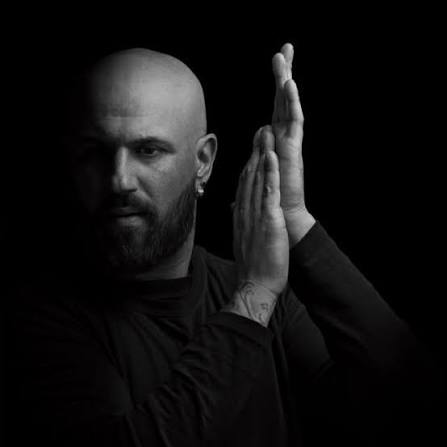
He began his journey in flamenco as a self-taught artist, inspired by his father, a passionate flamenco enthusiast. He later graduated in the cante specialisation at the Andalusian Flamenco School (EFA). From 2000 onwards, he began building his professional career performing at tablaos throughout Spain and touring with various companies. Since 2012, he has combined his artistic career with teaching as an assistant lecturer at ESMUC.
As a cantaor and palmero, he has performed at some of Spain’s most iconic venues, including Palau de la Música, L’Auditori, Palau Sant Jordi, Teatre Poliorama, Mercat de les Flors, Teatre Lliure and Sala Apolo. He has also performed at festivals and theatres in Germany, France, Austria, Belgium, Switzerland, Poland, Russia, China and Saudi Arabia, among other countries. Throughout his career, he has shared the stage with leading figures in flamenco singing and dance, including Antonio Canales, Juan de Juan, Rafaela Carrasco, El Junco, La Lupi, Guadiana, Antonio Reyes, Rosalía and Juan Carlos Lérida himself.
He has also collaborated on recordings with a diverse range of artists, including cantaora Rosario la Tremendita (A Tiempo, 2012), bassist Niko Torres, saxophonist Eladio Reinón (Misceladio, 2015), the duo Babel, and guitarists Yazan Ibrahim (Shams, 2021) and Jesús de Joaquín, Puchero (Bordón flamenco, 2021).
Bernat Jiménez de Cisneros
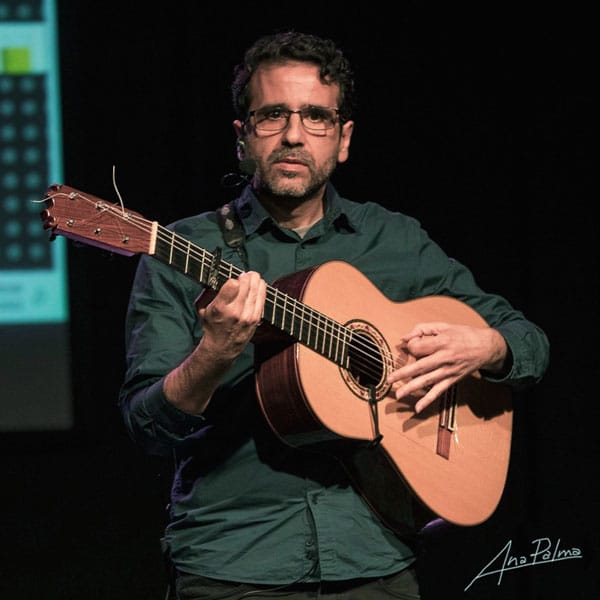
Photo: Ana Palma
Born in Barcelona, he holds a PhD in Musicology from the Autonomous University of Barcelona (UAB), a degree in Flamenco Guitar from the Conservatori del Liceu, and a Bachelor’s and Master’s degree in Fine Arts from the University of Barcelona (UB). He is the author of Ritmo y compás (2015) and Las palmas flamencas, which received the 2020 Extraordinary Doctoral Award. He is also the founder of AtrilFlamenco, a leading online resource for flamenco studies.
Since 1999, he has been teaching workshops in flamenco guitar, palmas and ensemble playing at civic centres and music schools, helping to build a broad community of flamenco enthusiasts and practitioners in Barcelona. He currently teaches the flamenco lyrics workshop at the Escola d’Escriptura de l’Ateneu Barcelonès and coordinates the Dimarts a Compàs cycle.
In academia, he has delivered papers at international conferences, published several articles in international journals, and contributed reviews and peer reviews for publishers such as Routledge and Cambridge University Press. He has also served on the scientific committee of the International Congress on Flamenco Studies and Flamenco Pedagogy, held as part of Ciutat Flamenco. In the field of artistic research, he has been a member of the Laboratory for Research from Flamenco since 2019.
Through participatory talks and round-table discussions, the Dimarts a Compàs cycle focuses on sharing knowledge and encouraging debate, with the aim of helping audiences enjoy flamenco on a deeper, more conscious level, while also opening up a space for constructive reflection on some of the challenges it faces today. The cycle also seeks to give visibility to local artists, who perform concerts related to each session’s theme and take part in the discussions, sharing their own perspectives on an art form and a profession that go far beyond simply “making ends meet”.
Cycle coordinator: Bernat Jiménez de Cisneros