By Lluís Cabrera
Photo: ©Maud-Sophie Andrieux
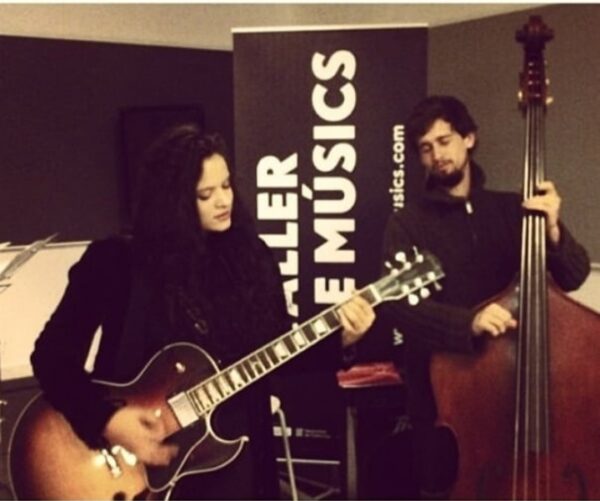
During her years of study at the Taller de Músics, Rosalía moved in and out of classrooms like a whirlwind. Our school in the Raval, a district of Barcelona, has undergone a particularly complex growth since 1979, occupying various spaces within the triangle formed by Requesens, Príncipe de Viana and Cendra streets, effectively turning the street itself into the school’s courtyard. This open environment encouraged learning beyond the academic setting: Rosalía also absorbed knowledge by interacting with artists, teachers and fellow students in this distinctive open-air space.
The philosophy of the Taller de Músics has always been eclecticism and flexibility, qualities that have defined it since its founding. This approach promotes group music practice (combos), the blending of genres, and the creation of platforms where students can perform in front of an audience. Rosalía fit perfectly into this pedagogical model, which prioritizes learning to speak before learning to write. From the JazzSí Club to the Teatre Grec, where she took part as a cantaora in a show inspired by Carmen Amaya, and from the Palau de la Música with Flamenkids to her appearance at Ciutat Flamenco, Rosalía demonstrated an artistic maturity that was remarkable for her age.
In January 2010, Rosalía enrolled for the first time at the Taller de Músics in the Raval neighborhood. Over the course of two years, she studied piano, music theory, flamenco singing, jazz singing, vocal technique and guitar. Among her teachers were Jaume Gispert, Chiqui de la Línea, Errol Woiski, Diana Palau, Xevi García and Cristina Canet, all of whom witnessed her tireless curiosity. After completing this stage, she continued her higher education at Can Fabra, in the Sant Andreu district, between 2012 and 2014. There she expanded her training in subjects such as music history, flamenco harmony, musical thought, flamenco forms and the fundamentals of composition, with instructors including Enric Marín, Alba Guerrero and Xavier Casellas.
Her participatory attitude led her to enroll not only in regular courses, but also in seminars, workshops, masterclasses and lectures. Rosalía asked questions relentlessly, sometimes incisively, displaying an innate restlessness that challenged those around her. Asking questions, after all, is essential for expanding knowledge and for building one’s own voice. This is precisely the attitude that the Taller encourages in its students: to observe, listen and question, because without questioning there is no evolution.
We understand that Rosalía gradually shaped her artistic vision with humility, avoiding arrogance and embracing simplicity. It is admirable how she learned through observation and listening, showing respect for the knowledge of others. This way of learning also enriches the institution itself. As Enrique Morente once said, “there are no masters, only disciples,” and Rosalía was an exemplary disciple who continually challenged us with her questions and reflections.
Rosalía’s impact on the Taller was also felt within her generation. Her aura attracted many young people who admired her, yet she herself was always seeking new horizons and experiences to broaden her creative universe. She understood the codes of flamenco and the keys of jazz, but without confining herself to any single genre. This versatility reflects the essence of the Taller: musical genres are means, not ends.
Perhaps she could have achieved her career on her own, but the Taller provided her with an idea-rich environment and a network of artists that enhanced her development. One day, her teacher Chiqui de la Línea remarked: “This girl is very special; she modulates in a way that, by constantly recalling the old masters, her expression feels contemporary. Rosalía will give people a lot to talk about.” And he was right.
Rosalía has ángel—a special spark—nurtured by her musical talent, tenacity, intuition, curiosity and an immense desire to learn. If we have managed to pass on knowledge to her without limiting her creativity, we feel deeply proud, because in her are reflected the values that the Taller has upheld for nearly 50 years of history.